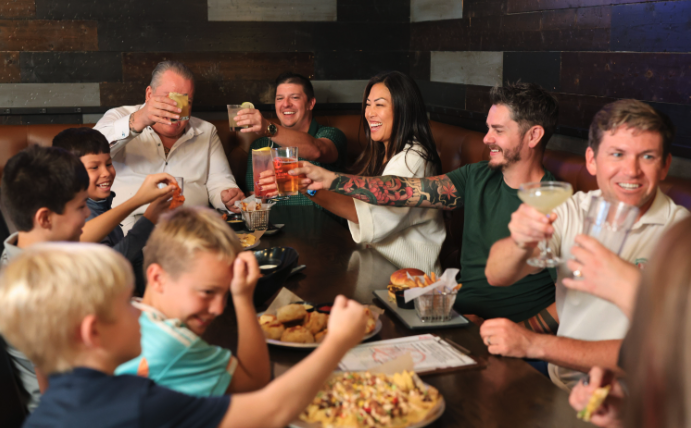

Food as a Core Attraction
At some centers, food fills time. At Pinheads Entertainment in Indiana, it fills the building.
On a busy evening at Pinheads, which operates two locations in Brownsburg and Fishers, the scene doesn’t resemble the traditional bowling center of decades past. Servers weave between lanes delivering cocktails and plated entrées. Families settle into a full-service restaurant for dinner while kids drift in and out of the arcade. A couple lingers at the bar, debating whether to hop onto one of the bowling lanes humming just steps away.
This fluid blend of dining, socializing, and play is no accident. At Pinheads, it’s one of the main reasons guests walk through the door.
Operating at that level, however, comes with its own set of challenges. Running a full-scale food and beverage program inside a high-energy entertainment venue is fundamentally different than operating a standalone restaurant, and worlds apart from managing a simple snack bar. Service must flex around games, events, leagues, and fluctuating guest flow, all while maintaining restaurant-level expectations for food, timing, and hospitality.
Pinheads operates multi-attraction entertainment venues that blend bowling with arcades, leagues, private event spaces, and social experiences. The goal is to give guests multiple ways to engage, stay longer, and come back.
“People are looking for experiences that are memorable,” said Ryne Barr, COO of Pinheads. “It’s multifaceted, and food and beverage play a huge component in that. We look to bring value, but value doesn’t always have to mean cheap or inexpensive.”
As entertainment centers across the country look for new ways to grow revenue, build loyalty, and differentiate themselves, Pinheads offers a compelling model; one that treats food and beverage not as a concession, but as a core brand pillar.
Takeaways Over Tasks
For much of bowling’s modern history, food service followed a simple, transactional playbook. Hungry guests ordered at a counter, waited for their food, and returned to the lane. That approach worked when visits were short, game-focused, and largely transactional. Today’s centers operate in a very different environment.
“When you look at it as a holistic experience, the traditional bowling model was very task-oriented,” Barr said.
As guest behavior shifted toward longer stays, more social experiences, and maximizing time together, that model began to show its limits. The rise of hourly bowling only amplified the issue, making interruptions like leaving the lane to stand in line, feel like a poor use of paid time and a disruption to the overall experience.
From Pinheads’ perspective, the solution was to invert the model entirely. Rather than asking guests to adapt to the kitchen, the kitchen adapts to the guest. “In a full-service model, we’ve got servers at the lanes and bring what they want to them,” Barr explained. “That allows the guest to focus on the experience rather than managing transactions.”
Food & Beverage as Brand Identity
Pinheads’ in-house restaurant, Alley's Alehouse, operates as a legitimate casual dining experience. The menu features thoughtfully plated entrées, elevated burgers, and a curated cocktail list, supported by a kitchen that leans into restaurant-driven execution.
That distinction becomes clear once you see what’s coming out of the kitchen:
Mamisake Bone-In Wings: Bone-in wings layered with soy and sake flavors, finished on the grill and seasoned with a savory umami profile.
Sesame-Crusted Tuna: A seared, restaurant-style entrée that relies on proper technique and quality ingredients, not fryer speed.
Bone Marrow Chimichurri Burger: A smash-style burger layered with sautéed onions, house-made sauces, and premium toppings, finished with rich bone marrow butter.
It’s a far cry from hot dog rollers and bright-yellow cheese on nachos. But this mindset reflects a long-held belief within the organization. “We’ve known this at Pinheads for going on 15 years now,” Barr said. “Quality food and beverage, if done right, can generate its own revenue just for people coming in for lunch or dinner.”
In other words, bowling, or other attractions don’t have to be the main draws. The food itself can bring people through the door.
Hospitality Talent in an Entertainment Center
Delivering that level of food and beverage experience takes more than upgraded recipes or better equipment. It depends on having the right people in place and the operational discipline to support them.
At Pinheads, food and beverage roles are treated with the same seriousness they would have in a standalone restaurant, because guest expectations are just as high.
“If we’re hiring directly into a server or bartender role, that previous background is required,” Barr said. “There are real challenges and complexities that come with operating a full-service bar and restaurant within a family entertainment center.”
Unlike traditional restaurants, service teams work inside a constantly moving environment. Guest flow shifts between bowling, arcade play, events, and walk-in dining, sometimes all within the same hour. Staff need to stay focused, adapt on the fly, and maintain consistent service even when the building is at full energy.
Finding people who can thrive in that setting, and giving them the structure to succeed, is a critical part of making the food and beverage program work.
A Disciplined Approach to Menu Development
Behind the scenes, Pinheads treats its menu as a living document, guided by data and guest behavior rather than intuition alone.
The company reviews its menu twice a year, typically in the spring and fall, evaluating sales performance, food costs, and guest response. Items that consistently rank in the top ten are rarely touched, and signature cocktails remain bar staples.
“That stability matters,” Barr noted. “Guests come back expecting certain things.”
At the same time, chefs are given room to experiment through seasonal features and limited-time offerings. This balance allows Pinheads to innovate without destabilizing operations, resulting in a menu that feels fresh but reliable, an important distinction for repeat guests.
Experience Over Gimmicks
Pinheads offers a range of promotions and programmed experiences, from wine dinners and music bingo to kids-eat-free nights, happy hours, and speakeasy-style events. But Barr is quick to stress that no single promotion is driving the business.
“For us, it’s not about specific promotions moving the needle,” he said. “It’s about the overall experience. Customers know they have no shortage of options.”
Rather than relying on deep discounts or short-term traffic drivers, Pinheads focuses on consistency, atmosphere, and service quality. Promotions function as extensions of the brand experience, not corrective measures.
That philosophy carries into how Pinheads markets its food and beverage program.
Online reviews are treated as a key driver of word-of-mouth and dining decisions.
Professional food photography helps position Alley's Alehouse as a legitimate dining destination, not just a bowling-side restaurant.
OpenTable integration allows guests to find and book the restaurant the same way they would any standalone concept.
Smart SEO strategies ensure the restaurant shows up where diners are already searching.
The goal is to make Alley's Alehouse discoverable and appealing to guests who are looking for a place to eat, whether or not entertainment is part of their plan. In many cases, guests arrive for dinner first and discover the rest of the building organically. A couple may stop in for a meal and return later with friends to bowl. Parents enjoy dinner while kids spend time in the arcade. Guests who didn’t plan to bowl on their first visit often do so on the next.
That natural cross-traffic strengthens the entire business, not just the restaurant.
Lessons for Other Operators
For center owners considering an elevated food and beverage program, Barr’s advice is straightforward. “If you’re going to commit, you have to be all in,” he said. “Is it going to go perfectly? Probably not. Are you going to make mistakes? Yep. But you learn from those mistakes.”
“Eventually, you’ll find yourself with an elevated food and beverage offering that you can be proud of,” Barr said.
Half-measures, he warns, often lead to disappointment. Treating food and beverage as an obligation rather than its own business can drain resources without delivering meaningful returns. The payoff for full commitment, however, extends beyond revenue.
For operators looking to future-proof their centers, the takeaway is clear: when food earns its place at the table, the entire business gets stronger.