
Where Savvy Operators Are Betting
If the past five years felt like a rollercoaster, marked by sudden surges in demand, changing consumer behavior, and constant fluctuations, the next five will be about sharpening your edge. Entire industries have been reshaped almost overnight by technology, shifting expectations, and the way people choose to spend their time and money. Bowling and family entertainment are no exception.
History shows that businesses that thrive aren’t the ones clinging tightly to what worked yesterday. They’re the ones willing to pivot and evolve. Companies that stayed nimble during previous economic swings, generational shifts, and tech booms capitalized on the changes. That’s why successful entrepreneurs keep an eye on where we’ve been, but they’re always watching where things are headed next.
As president and founder of Turfway Entertainment, I’ve spent years working alongside owners and operators, both as an operator and a consultant, helping centers tackle real-world challenges - from food and beverage performance to layout, staffing, and modernization. The insights that follow come directly from that hands-on experience across both new and established operations.
The Demographic Wake-Up Call
The tough reality is that traditional, singular attraction models are becoming increasingly difficult to sustain as a long-term strategy. Other vertical markets are experiencing this as well as traditional bowling centers. As traditional leagues have declined, many operators have successfully pivoted to casual, social leagues built around food, drinks, and flexible formats. It’s a smart move, but it’s not the whole answer. Today’s guests expect more than a league night; keeping them coming back means thinking beyond leagues altogether.
Here are some eye-opening facts:
• According to recent United States Bowling Congress (USBC) data, league bowlers skew significantly older than today’s casual guests.
• The average league bowler is now estimated to be age 55 or older.
• Surveys of United States Bowling Congress (USBC) championship participants show that approximately 70–72% of committed league bowlers are over age 50, while only about 3% are under 30.
Why does this matter?
Because there's a massive age gap in the industry, your casual guest, the one coming in for open play, corporate outings, social events, or birthday parties, is often in their 20s or 30s. Meanwhile, the league-based recurring revenue base is steadily aging out.
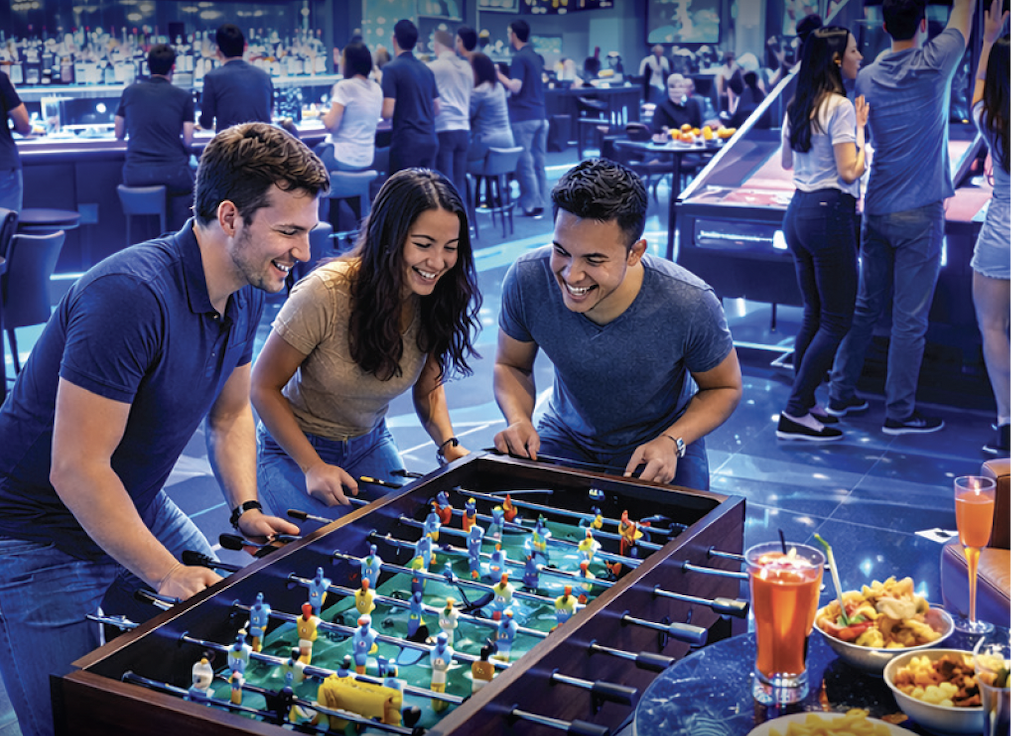
That reality forces a shift. As traditional leagues struggle to attract the younger guests who now drive food and beverage spending, operators are leaning harder into social gaming and micro-attractions. What’s emerging is a more sophisticated social sanctuary where bowling remains the anchor but no longer has to carry the entire load.
The real question over the next five years isn’t whether diversification matters; it’s how well operators elevate food, introduce the right mix of smaller attractions, and design spaces that encourage people to connect and stay longer.
1 THE BET ON EATERTAINMENT
The days of relying on frozen pizza and draft beer to drive secondary revenue are over. Everyone has to eat, but they don’t have to be entertained. By 2028, industry data suggests that food and beverage will shift from a supporting role to a primary driver of foot traffic.
The rise of the foodie/gamer is real. These guests don’t visit a venue and then happen to eat; they choose a venue because of the menu, and then they happen to play. Thanks to social media’s influence on Gen X, Millennials, Gen Z, and the upcoming Alpha generation, expectations are higher than ever. Guests want:
• Instagram-worthy craft cocktails
• Shareable, elevated plates
• Health-conscious options that rival local gastropubs
This is such a driving part of the business that, through our consulting work at Turfway Entertainment, we’ve added dedicated culinary and bar services departments to support operators looking to maximize this side of their business. Here are some solutions that have gained popularity among guests and other operators.
• Fork-Free Dining: Heavy bets should be placed on high-quality, handheld menu items that facilitate social flow. Think of gourmet sliders, elevated tacos, and skewered bites that don't interrupt the game.
• The Sip Economy: Alcohol margins remain the king of profitability. Operators are increasingly installing self-pour beer walls and hiring mixologists to create signature venue-themed cocktails.
• The Verdict: If your kitchen is an afterthought, your venue will be too. Enhance your culinary talent before upgrading other aspects of your facility.
SMALL-SPACE MICRO-ATTRACTIONS
With real estate costs rising, the massive 50,000-square-foot mega-center is becoming increasingly difficult to sustain. From 2025 to 2030, the winning strategy is density. Operators are turning to boutique attractions, small-footprint, high-throughput games that maximize revenue per square foot.
Guests are seeking variety and velocity. The attention span for a two-hour, 10-frame game is waning among Gen Z and Alphas. They crave rapid-fire, round-based entertainment that allows them to rotate through multiple experiences in a single night. That's one reason arcades consistently generate some of the highest revenue per square foot if they're set up and maintained properly. Short play times, instant rewards, and repeatable experiences mirror the dopamine hit of swiping on a phone.
What’s Clicking with Guests:
Arcades: Similar to bowling, arcades can reach all ages. They have been around forever, but have broad appeal across all ages as they continue to evolve to meet the needs of the new customer base. These are the MVPs of the next five years, provided they are set up and operated correctly. They require less space at 70 square feet per piece, do not require rental shoes (removing a major friction point), and offer shorter game times. This allows for a very popular and profitable ancillary attraction while keeping waiting groups engaged.
Tech-Augmented Darts and Mini-Golf: Traditional pub games are getting a gamified overlay (think auto-scoring darts or projection-mapped putting greens). These attractions command a premium price point while requiring minimal staffing. Be careful, however, as many are "bar-centric," and the synergy needs to be there to drive top-line revenues and bottom-line profitability.
Don’t Underestimate the Vibe: Swap underperforming party rooms and unused concourse space for open social gaming zones. A large arcade integrated with dining opportunities often generates considerably higher revenue per square foot than a party room that sits empty 95% of the time.
Remember, though, the key is openness. Entertainment thrives on energy, and energy comes from sound, light, and movement. Isolated dining rooms tend to mute that effect, while open arcade and gaming concepts amplify it, creating a buzz that pulls guests in and keeps them engaged.
3. DESIGNING FOR HUMAN CONNECTION
In an increasingly digital world, FECs are becoming fourth spaces distinct from home, work, and coffee shops; they are designed specifically for active social connection. The loneliness epidemic is real, and post-COVID reopening data proved it. Some properties saw revenue increases exceeding 200% as guests returned, craving shared experiences.
Guests don’t just want to play next to each other anymore; they want to play with or against others. Passive entertainment, like watching a movie, is losing ground to competitive socializing.
How some operators are leaning in:
• Lounge-First Layouts: The settee-style seating of the past is being replaced by soft, living-room-style layouts. Lanes are being booked not just for the game, but for the couch with dining opportunities while they play. Operators are betting on furniture that encourages face-to-face conversation rather than everyone facing the pins.
• Social-Centric Tech: Invest in scoring systems that integrate with guests' phones for global leaderboards, instant replay sharing, and selfie moments. Technology should facilitate the "bragging rights" economy. Brunswick and QubicaAMF have both gamified their systems, with significant results when used correctly.
• The Verdict: Stop selling frames and start selling parties. Design your layout so that a group of six feels comfortable staying for three hours, even if they only bowl for 45 minutes.
WHAT WINNING WILL LOOK LIKE IN 2030
The successful FEC of 2030 will look less like a bowling alley and more like a boutique hotel lobby that happens to have games.
• The Vibe: A hybrid of a high-energy sports bar and an upscale lounge.
• The Tech: Invisible but omnipresent (mobile ordering, frictionless check-in, gamified loyalty programs).
• The Experience: A seamless flow between eating, drinking, and short-burst competitive gaming.
The next five years are about the density of experience. Place your bets on attractions that bring people closer together physically and menu items that keep them seated longer. The era of renting shoes is ending. The era of making memories has begun.