
Fixing Machines and Teaching the Next Generation
For as long as people have been bowling, someone has had to keep the pins standing, the balls rolling, and the sweeps sweeping. For decades, that meant skilled mechanics crawling beneath and behind the lanes, armed with wrenches, patience, and a knack for keeping clattering machines alive. These days, sadly, those mechanics are more complex and harder to find. But tucked over in western New York, near the shores of Lake Erie, one young man is making sure their knowledge doesn't vanish with them.
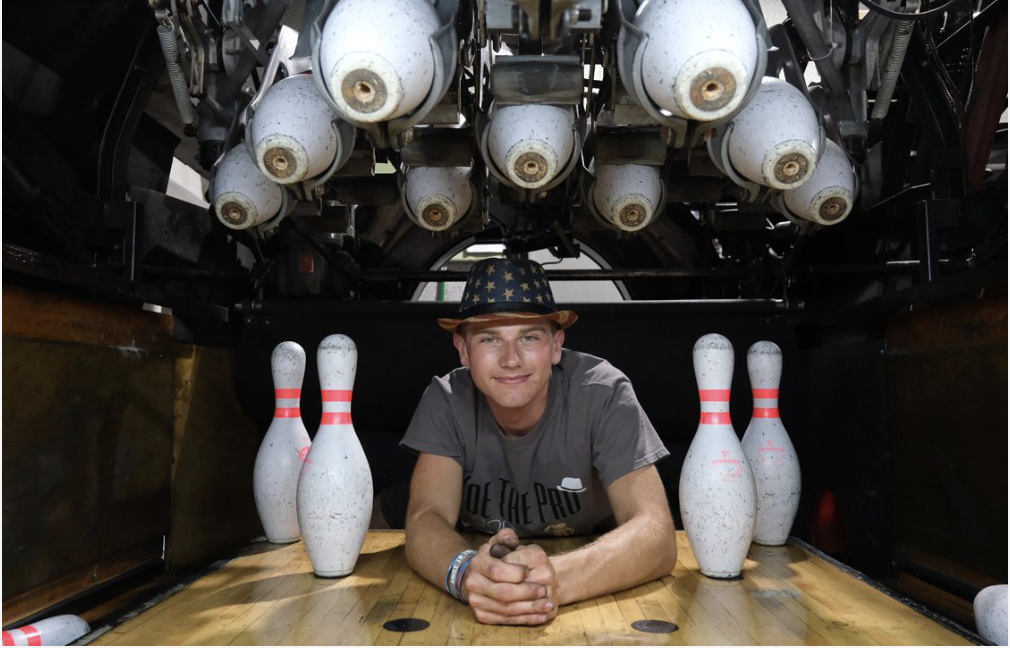
Joey Dayer, a 20-year-old college student from Hamburg, New York, may be the youngest pinspotter specialist in America. He spends his evenings elbow-deep in decades-old AMF machinery at Cloverbank Bowling, a GoPro camera strapped to his head, recording all the while, helping maintain the same center where he first fell in love with the mechanics of the game. Between classes at Buffalo State University, where he's studying to become a teacher, he preserves and repairs a dozen vintage pinspotters—machines that most of his peers wouldn't know how to turn on, let alone take apart, analyze, and rebuild.
“I think the youngest mechanic I work around is in his late forties,” Dayer said. “So, in a way, I’m just trying to start a new generation of this.”
An Unlikely Beginning
Dayer’s fascination began, fittingly, with a gift from his father—a set of plastic pins and a toy bowling ball. As a kid, he’d line them up in a straight row, puzzled that real lanes reset pins in a triangular formation. His curiosity led his father to arrange a visit to local Cloverbank Bowling, where a hall-of-fame proprietor, Pete Cambio, gave the young boy a peek behind the curtain.
From that day forward, Joey was hooked. Or, instead, pinned. He begged to go in the back again each time he visited. And when he wasn’t at it there, he was on YouTube, watching grainy instructional footage on how pinspotters worked. “I would go home and search it up and sit and watch videos of the machines,” he said. “That’s how I got my first real knowledge of them. But once I started working on them myself, that’s when I really learned everything.”
Over the years, curiosity turned to mastery, and he’s since completely disassembled and rebuilt all 12 of Cloverbank’s AMF 82-30 machines, replacing worn belts, aligning conveyors, pressure washing table assemblies, upgrading from the old Vertical Ball Lifts to Positive Ball Lifts (PBLs), and fine-tuning distributors to keep the system running like new. That kind of hands-on devotion also meant finding every extra basement he could to stash the steel odds and ends and bits of machinery that came with the job. He jokes, “People say my mother’s a saint for letting me store these parts in her home.”
The Influencer Mechanic
As his skills grew, so did his desire to share them. Dayer launched a YouTube channel, Joe the Pro, which has since become a hub for mechanics, enthusiasts, and bowling purists worldwide. Offering a unique perspective via his GoPro, Dayer gives viewers a gearhead's eye view at the inner workings of pinspotters, curtain assemblies, re-spot cells, and every nut and bolt in between. His detailed breakdowns of each component have drawn thousands of views and a dedicated niche following.
On Sunday nights, he hosts a livestream from his back-room workshop at Cloverbank. There, he fields questions from viewers, takes repair requests, and sometimes helps troubleshoot machines in real time. On one memorable night, a center owner from Australia tuned in after struggling to repair his vintage AMF setup. “He had the same old verticals we did, but a little different,” Joey said. “He didn’t understand a few things, and I helped him figure out what to look at. He found a breakthrough right there during the stream.”
To Dayer, the channel isn’t just about showing off repairs. It’s about teaching. “I’m going to school to be a teacher,” he said. “I like helping people learn, and that’s kind of the way people are learning now. Even how to change a car tire—people go to YouTube. So why not drag bowling into it, too?”
A Restorer of History
That mindset led him to one of his proudest projects: reviving the long-dormant lanes at Corpus Christi Church in Buffalo’s East Side. Built in 1928 as part of a Polish-American athletic club, the 12-lane alley had been silent for more than a decade, its pinspotters and surfaces gathering dust.
Yvonne Bennett, a bowling historian and former executive director of the Bowling Centers Association of Wisconsin, stumbled upon the forgotten lanes during a 2024 visit. “I totally geeked on this place,” Bennett says. “It was so amazing. It was like stepping back into the 1940s or ‘50s.”
After posting a call for help online at various mechanic and bowling enthusiast pages and Facebook hubs, she got a reply within an hour—from Dayer. "When I opened his Facebook page, I saw this literal teenager and didn't think much of it," she admitted. "But then I checked his Joe the Pro channel and realized, oh man, this guy's legit."
Fitting work sessions in between his college classes, Dayer spent months repairing and tuning all 12 machines, replacing rusted parts and coaxing the old systems back to life. By winter, the lanes were again hosting holiday gatherings and community parties.
Bennett called it “a small miracle.” For her, Joey represents more than a gifted mechanic; he’s proof that the tradition of maintaining classic pinspotters still has a future. “What’s going to happen when our generation retires?” she asks. “Who’s going to be the next generation of proprietors, mechanics, pro shop owners, and media people to replace us? Joey’s passion shows there’s still hope.”
The Vanishing Trade
The craft Dayer practices is part art, part science, and it’s becoming increasingly rare. Many of the AMF and Brunswick pinspotters still in use date back to the 1950s and ‘60s. As centers look to reduce maintenance costs, some have switched to newer string pinspotters —simpler, cheaper systems that use cables rather than traditional mechanical arms and distributors.
“You walk into some of these places and you’re finding things duct-taped and tie-wrapped together,” Dayer says. “It’s ridiculous. You can only do so much to patch things up. You need funding and people who know what they’re doing to keep them alive.”
His goal, he says, is to teach centers that proper upkeep pays off: “If you do it right the first time, your machines will serve you a lot longer.”
Passing It On
Even as he looks ahead to a career in education, Dayer plans to keep his mechanical work going on the side, both as a service and as a teaching tool. "If I were planning on only doing this temporarily," he joked, "I wouldn't have filled up two basements with bowling machine parts."
For him, Joe the Pro is more than a hobby channel—it’s an archive. Each tutorial, livestream, and walkthrough helps preserve knowledge that might otherwise disappear when the last generation of pinspotters mechanics retires.
Bennett believes that preservation is precisely what the sport needs. "Joey's podcast and videos are fabulous," she says. "His passion is evident, and I love that his story is nowhere near done."
As Dayer himself put it: “We’ve got to start somewhere.”
And somewhere, in a quiet workshop behind twelve humming lanes at Cloverbank Bowling, the next generation of bowling’s unsung mechanics has already gotten started.