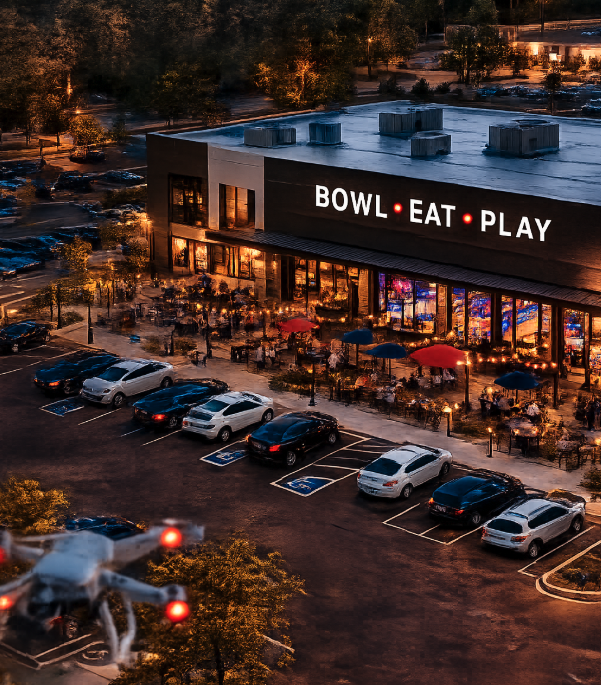
Drone Video Drives Visits
For many centers, one of the hardest parts of marketing is helping customers understand the experience awaiting inside the building. That challenge becomes even bigger when a center has been renovated, repositioned, or is trying to attract guests who still picture the business the way it looked years ago.
That was the difficulty facing Michael Ducat and his team after transforming an older bowling center into a modern, 70,000 square foot entertainment facility. Traditional marketing materials were not fully communicating the scale of the transformation or the variety of experiences now inside the building.
“We kept posting pictures, but people still didn’t really understand what we had built,” says Ducat, proprietor of Incredibowl Entertainment in Toledo, Ohio. “A lot of people remembered the old center, but we needed to show them this wasn’t the same place anymore.”
The center hired a professional drone company to produce aerial footage showcasing the facility’s attractions, event spaces, sports bar, and overall layout. Ducat says the project cost approximately $3,000 for the full facility, and the investment quickly proved worthwhile.
“We wanted corporate clients to see we’re not your average place,” he says. “Pictures just weren’t capturing the whole experience.”
The footage now appears throughout Incredibowl’s website and social media marketing, and Ducat says customers frequently reference the videos when discussing parties and group events. The center has even added QR codes linking directly to the footage on printed marketing materials and mailers.
“There’s really no better way to showcase your business,” Ducat says. “People finally understood what we had here.”
THE OVERHEAD VIEW
In a crowded online environment, first impressions matter more than ever. Static photos and standard walk-through videos still have their place, but drone video is giving operators a more effective way to showcase energy of their centers.
Gavin Peeler, a New Mexico-based marketing professional specializing in aerial cinematography, has seen the shift up close. His work ranges from local tourism campaigns in Roswell to large-scale festivals, and increasingly, businesses that want to stand out in a fast-moving feed. “The first three seconds are everything,” Peeler explains. “If you can show scale and movement right away, people stop scrolling.”
One of the biggest challenges is helping potential guests picture the experience before they arrive. Aerial footage captures the full property, the energy of the space, and the variety of attractions in a single shot, making it easier for viewers to understand what makes the destination worth visiting.
A website can list attractions. A photo can show a lane or an arcade game. But neither answers the customer’s real question: Is this place worth my time? Drone footage answers that in seconds.
DIFFERENT USE, DIFFERENT CENTER
While some operators are using drone footage to showcase large-scale renovations and repositioned entertainment concepts, others are using it to reinforce community visibility.
For Jensen Beach Bowl in Florida, drone footage became more than a visual upgrade. It became a way to introduce the center to a changing community. Nicole Sprague, a second-generation proprietor, says the area has experienced significant residential growth, but many of the new developments are located away from the older section of town where their center has operated since 1958.
“We've had such an influx of residents in the area,” Sprague explains. “Getting the word out that there is this non-chain FEC option in the older area is important. It's not as well traveled as where all the new builds are.”
Drone footage helped bridge that gap by showing new residents the scale, activity, and atmosphere of the center in a way traditional photos could not. For Sprague, the footage also serves another purpose: helping independent centers stand apart from larger corporate competitors. “We need to showcase that traditional FECs still exist,” she says. “They're still very functional and very inviting.”
That same approach has also become an effective way to reach younger audiences. Sprague reports that their drone videos have become especially valuable for youth marketing and birthday party promotion. “It keeps us front-of-mind, especially for the elementary and middle school age kids,” Sprague says. Elementary-age children are booking birthday parties, while middle schoolers represent the next generation of league bowlers. “We want to keep them engaged so they continue bowling into their high school years, especially since all of our local high schools have bowling teams.”
NOT JUST A PRETTY SHOT
The video may be what catches someone's eye, but the strategy behind it is what drives results. Whether the goal is showcasing a renovation, introducing a center to new residents, or attracting a different demographic, the footage still has to accomplish something.
"The drone isn't the marketing strategy," Peeler says. "It's one of the tools. The footage has to match your brand, your audience, and what you want people to do next." And that’s where planning makes the difference. The same footage can become a quick social media ad, a homepage video that immediately sets the tone, or event promotion that shows real crowds instead of asking people to imagine them.
A long cinematic video may look impressive, but short, usable clips usually work harder. The strongest pieces give viewers a fast reason to click, book, or learn more.
FROM EXPENSIVE LUXURY TO AFFORDABLE TOOL
The good news is that drone video is no longer reserved for big marketing budgets. As the technology has become more affordable, it has shifted from a luxury to a practical marketing investment.
What once required a high-end production can often be captured in a single afternoon, making it far more realistic for centers to create fresh seasonal content throughout the year. A busy summer event, a fall league kickoff, or a holiday celebration can all be filmed and turned into new marketing material without starting from scratch.
Before you hire: Commercial drone work in the United States requires certification through the Federal Aviation Administration. Operators must hold a Part 107 Remote Pilot Certificate. If you are hiring a drone professional, make sure they are properly licensed and insured.
CONTENT TO CONVERSION
Getting attention is only the beginning.
The real value of drone video is what the shot makes someone do next: Click. Book. Show up.
That means thinking beyond the footage itself. Where will the clip appear? What action is it meant to inspire? How often will it be refreshed? When used with a purpose, drone video becomes more than a visual upgrade. It becomes another tool for turning interest into visits.
"The goal is not just to impress people," Peeler says. "It's to give them a reason to come in."
Making The Most of Aerial Content
• Homepage hero video
• Google Business Profile
• Facebook and Instagram ads
• Birthday party landing pages
• Corporate event promotions
• Email marketing
• Digital sales presentations
Before You Hire A Drone Company
• Verify FAA Part 107 certification
• Confirm insurance coverage
• Ask for raw footage files
• Request vertical video versions
• Get clips for multiple seasons
• Discuss usage rights upfront